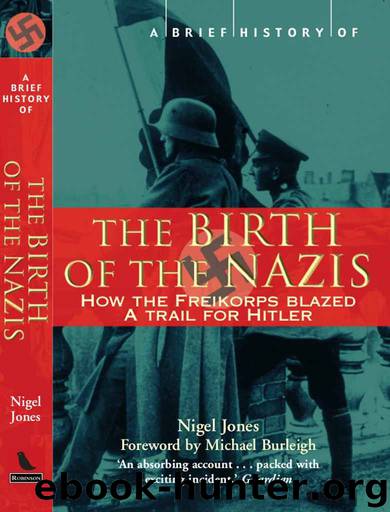
A Brief History of the Birth of the Nazis by Nigel Jones
Author:Nigel Jones [Jones, Nigel]
Language: eng
Format: mobi
Publisher: Constable Robinson
Published: 2012-08-20T04:00:00+00:00
In a last effort to buy the allegiance of the populace, Munich’s Finance Commissar, a twenty-five-year-old bank clerk named Emil Männer, had the city’s printing presses rolling night and day to churn out worthless banknotes. But paper money could not hold off the inevitable: on 29 April, the Gorlitz Freikorps captured Dachau, scene of Toller’s triumph the week before. The next day the ruling revolutionary council had its last meeting. By the evening of that day, 30 April, only Toller and Egelhofer remained to organise the defence from their HQ in the War Ministry. As they talked, a false report came in that the Whites were in the city and had taken the railway station. The rumour was enough to touch off a mass desertion, and within minutes Toller and Egelhofer found themselves almost alone in the huge ministry. Only Egelhofer’s bodyguard, a twenty-year-old sailor, stayed, calmly stuffing grenades into his pocket.
Emboldened by the approach of the Freikorps and the decay of the Red defences, Munich’s bourgeoisie rose up to speed their liberation. They seized the Wittelsbach palace, the Rezidenz, and substituted the old blue and white Bavarian national banner for the Red flag. The city’s clergy rang the bells in cathedrals and churches to celebrate deliverance from Godless Communism.
On the outskirts of Munich, a Freikorps armoured train rained shells on the city, while aircraft from its air squadron droned overhead dropping leaflets combining threats with promises of liberation. In desperate panic, Egelhofer ordered that the hundred or so bourgeois hostages held in Munich’s jails be massacred. Most of the hostages were held at the Luitpold Gymnasium, where they were in the care of a discharged former Bavarian army officer named Seidel. Upon receiving Egelhofer’s murderous order, Seidel had his captives pushed in pairs to a wall where they were shot and bludgeoned to death. When Toller heard what was afoot, he rushed to the scene and stopped the slaughter, but not before some twenty of the hostages had been killed in a horrible fashion, probably by Russian former prisoners of war who had carried out the grisly task after German Red Army members refused to take part. Rumours swept the city that the genitals of the male hostages had been hacked off and thrown in a dustbin. Students slipped through the lines to report the massacre to Epp and Ehrhardt who immediately ordered their men into Munich – a day earlier than planned.
Many of the murdered hostages were leading figures in the Thule Society, held responsible by the Reds for the murder of Kurt Eisner. The Reds had only narrowly missed netting two future Nazi leaders who evaded the hostage trawl – Rudolf Hess, who slipped away to join Epp’s Freikorps, and Adolf Hitler himself, who, he later claimed, held off the three Red Guards who came to capture him on the morning of 27 April, with a rifle. Other hostages – like the murdered Prince Thurn und Taxis Hohenlohe – were monarchist members of Munich’s aristocracy.
On the morning
Download
This site does not store any files on its server. We only index and link to content provided by other sites. Please contact the content providers to delete copyright contents if any and email us, we'll remove relevant links or contents immediately.
| Anthropology | Archaeology |
| Philosophy | Politics & Government |
| Social Sciences | Sociology |
| Women's Studies |
The Secret History by Donna Tartt(19102)
The Social Justice Warrior Handbook by Lisa De Pasquale(12197)
Thirteen Reasons Why by Jay Asher(8918)
This Is How You Lose Her by Junot Diaz(6893)
Weapons of Math Destruction by Cathy O'Neil(6284)
Zero to One by Peter Thiel(5807)
Beartown by Fredrik Backman(5766)
The Myth of the Strong Leader by Archie Brown(5512)
The Fire Next Time by James Baldwin(5454)
How Democracies Die by Steven Levitsky & Daniel Ziblatt(5223)
Promise Me, Dad by Joe Biden(5157)
Stone's Rules by Roger Stone(5090)
A Higher Loyalty: Truth, Lies, and Leadership by James Comey(4966)
100 Deadly Skills by Clint Emerson(4931)
Rise and Kill First by Ronen Bergman(4797)
Secrecy World by Jake Bernstein(4756)
The David Icke Guide to the Global Conspiracy (and how to end it) by David Icke(4722)
The Farm by Tom Rob Smith(4516)
The Doomsday Machine by Daniel Ellsberg(4493)
